
 DoctorEldritch
Hello Legion Gamers!
Last week, our very own @CandelaSynth had the pleasure of chatting with Conrad Roset, the art director of Neva and one of the three pillars who founded Nomada Studio. Below is a transcript of their conversation, translated into English, where he shares more information about Nomada, Gris, and their latest release, Neva.
Hello, Conrad! Could you tell us a bit more about yourself and the origins of Nomada Studio?
I studied Fine Arts in Barcelona, and my first job was at Zara, designing t-shirts for the brand for a year. After leaving Zara, I started working as a freelance illustrator for various projects with other brands and advertising agencies. I also did art exhibitions and worked with publishers.
I have been doing this for 8 or 10 years. Hmmm, I can’t remember exactly!
It was going pretty well, but at some point, I told myself: "I want to change, I want to explore new territories." I’ve always loved drawing, but I also loved video games. So, I thought about combining these two passions and seeing what I could bring as an artist to the video game world.
By chance, one night at a party organized by a mutual friend, I met the two people who are now my partners at Nomada: Adrián Cuevas and Roger Mendoza. At that time, I already had the idea of making a game that started in black and white and, as you progressed, the world would be painted with colour. They had worked at big companies like Ubisoft, and they wanted to join the adventure of making our own game. And that’s how Gris was born!
How was it to start an indie project from scratch, and how did you secure funding?
It was very tricky! When I met Roger and Adrián, we set out to make a playable demo of about 15 minutes of what we had in mind, and we worked on it for 6 months because, of course, we had to create everything from scratch.
Then, we went to Gamescom in Germany to pitch this demo. We met with 13 or 14 of the biggest publishers, like EA, Sony, Microsoft, Nintendo, Devolver, etc. And from the moment we went to the fair until they approved the budget for Gris, another 6 months passed: 6 months of negotiations, sending PDFs with the game idea, budgets... basically, lots of bureaucracy! I remember it as a turbulent time, with more and more publishers dropping out because they thought it was too risky of an idea. Fortunately, Devolver Digital, our current publisher, believed in us and funded the project. And we’re really happy! But yes, we had to work very hard to get there.
Where does the name Neva come from?
Neva means “it snows” in Catalan, and it comes from the word neu (snow in Catalan).
Ahhh, right, that’s why life in the game is represented by snowflakes... 😊 Could you share with us how the transition from Gris to Neva was, in terms of aesthetics and game mechanics?
Creating a specific aesthetic for Neva was one of my biggest headaches. I was sure I didn’t want to do the same style as in Gris...
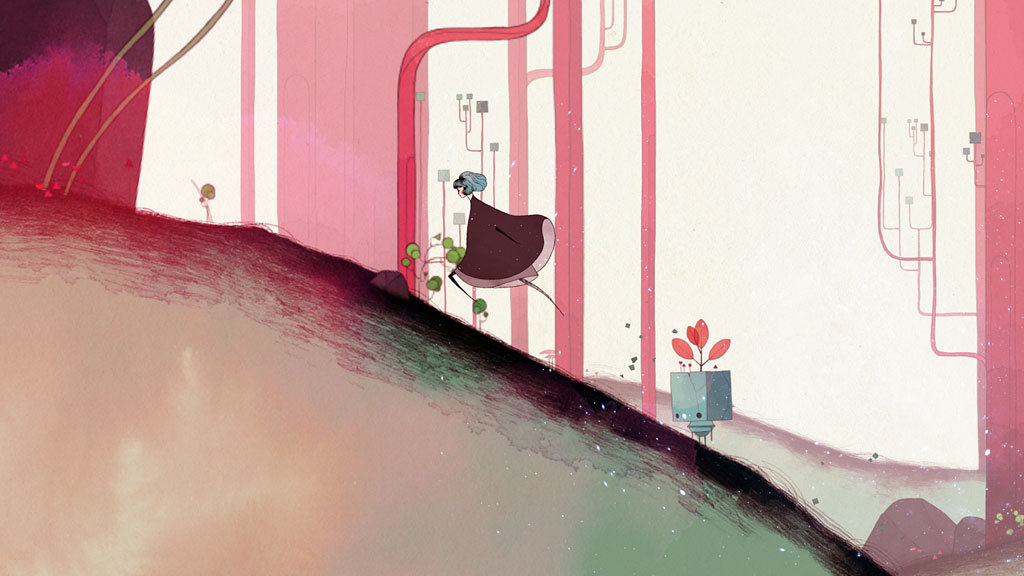
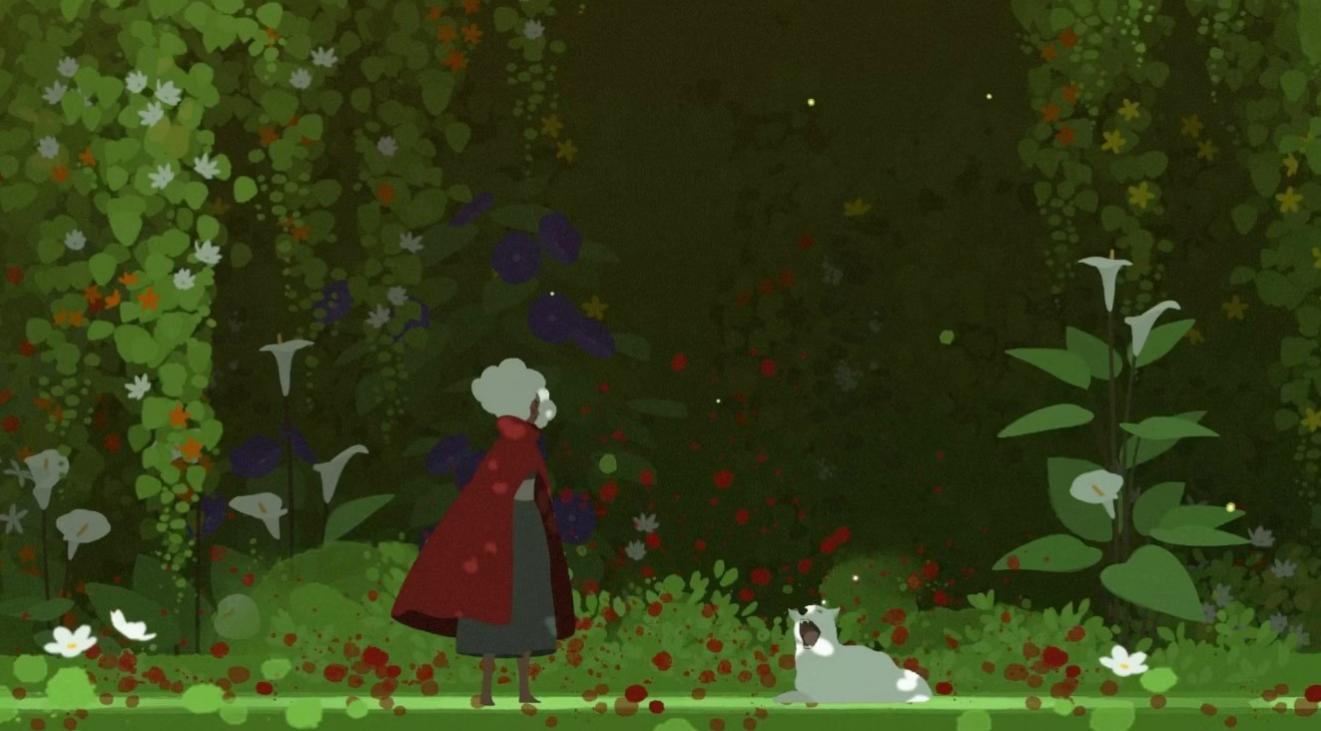
For example, in Gris, there are pencil lines and paper textures to try to emulate what would be a traditional watercolour painting. But in Neva, we eliminate the lines and express everything using flat colour shapes, and we play a lot with atmosphere and lighting changes. It’s another artistic language.
For me, the main goal as creative director at Nomada is to keep making games with visual coherence but without repeating the same style. And I think we’ve achieved that because I’ve seen reactions from people watching the trailer, and they quickly associate it with “the Gris creators.”
GRIS
NEVA
In terms of game mechanics, at the start of the project, we asked ourselves, “What if we made Gris, but with action?” And although action isn’t the focus of the game, we wanted to add combat elements to the puzzles and platforming. For example, there’s no experience tree where you can develop your abilities; rather, new abilities manifest as Neva grows.
However, many Gris fans came from a "non-gamer" background, so we also wanted to include a mode where you don’t die, for those who want to enjoy the story without feeling overwhelmed.
In the end, we added a new mechanic as a challenge and to explore other genres without repeating the formula from the previous game. And when we do a third game, we’ll think about what else we can add to differentiate it from Neva.
Are you planning to release a DLC, for example, with Neva as a playable character?
Yes, we’ve thought about it... but generally, we prefer to do closed projects so we don’t overdo it. But it could happen. With Neva, I think it’s more feasible than with Gris.
We could expand on what came before, how they met... I also thought about doing a prologue where you play as the wolf. That would be really cool. And even though it’s not exactly a DLC, we are preparing the art book because there’s a lot of material that wasn’t shown in the game, and if we don’t release it, it will just stay in our computers “gathering digital dust” 😁.
What did you enjoy the most about this project, and what was the most difficult part for you?
What I enjoy the most in any project is the beginning and the process of creating characters, the world, the atmosphere, etc. It’s always a magical moment when we do a lot of research, and the puzzle pieces start to fall into place. That’s what I enjoy the most as an artist.
On a personal level, the most difficult part was learning to delegate. In Gris, I did much more of the execution myself, while in Neva, I had to direct more. In Gris, the team was smaller, about 8 or 9 people, while in Neva, we had double the staff most of the time.
What was more complicated was learning, not so much to draw everything myself, but to be the art director. It was also tough learning to coordinate all the creative teams (art, design, music), so they were connected and coherent.
As for the business side, we’ve also learned a lot: running a company of 10 people is very different from running one of 25. None of us were entrepreneurs! We were artists and programmers, and we had to learn everything from scratch.
In this sense, we’ve also learned a lot from the projects that didn’t make it. Sometimes we started something, worked on it for 3 or 4 months, and for whatever reason, it didn’t pan out. Those unfinished projects were very important for us. Other challenges were learning how to sell the product, and how to talk to big companies... Overall, I’m very happy with Nomada as a studio and the position we’re in as a company with only two games 😊.
Of course, you have many reasons to be proud of your success! What can you tell us about your audience? Is there a particular region where Neva has performed better than others?
Well, I don’t have much data for Neva yet, but for Gris, I can tell you that the USA, Russia, China, and within Europe, Spain, Germany, France, and the UK have been key markets. And in the rest of the world, Brazil and Turkey have also performed very well for us. As I said, I’m incorporating data from Gris because I don’t have much information yet for Neva, but from what I’ve seen, it’s pretty similar. The USA is always first, China second (though that’s also because of population size). For example, Gris performed really well in Brazil—not only in sales but also in very positive comments on social media in Portuguese/Brazilian.
And what about your influences, both from popular culture and video games?
We have a ton of influences! Particularly from outside the video game world. Although, of course, we are inspired by the industry too! Games like Shadow of the Colossus, Journey, Limbo, Inside, The Last Guardian... have left a mark on us. Or, for example, in architecture, we’ve taken inspiration from Monument Valley.
But we’ve drawn from a wide variety of sources: sculptors, classical painters, Ghibli, Disney, Pixar animation... We also look a lot at contemporary art from artists who have a similar style and can offer us ideas. I’d say that during the first year, we do a lot of reference hunting, taking bits from many sources until we find our own language.
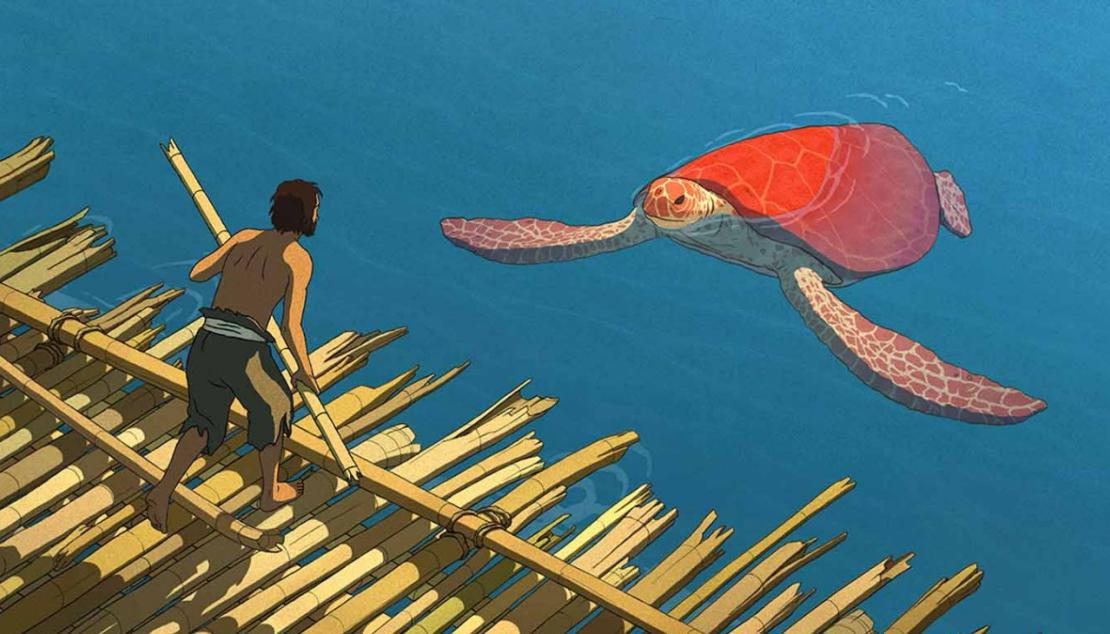
For example, in Gris, a film that really marked me was The Red Turtle: a work without dialogue, yet with an incredible narrative ability.
Since we're talking about "narrating without words," one of the things that has impressed me the most about Neva is the atmosphere you've created. What can you tell us about the "lore"? I imagine that when creating this world, you've considered many details that, while not explicit, players can infer...
Yes, absolutely. We have more information than our audience because we needed to create a coherent world. For example, I'll talk about the enemies.
We explain in the intro how a bird dies and black flowers grow from its body. As you progress through the game, you can see how this corruption is spreading and wilting the world where Alba and Neva live. Then you can see how those enemies eat the flowers and feed off that corruption, becoming part of it. These little details are the tools we've used to subtly show how this world works without providing a direct explanation.
If you had to condense the narrative, what would you say are the main themes of the game?
Neva has two fundamental pillars: one is maternity/paternity, which is shown in the bond between Alba and Neva. When I wrote Neva, my first child was two years old, and this life experience, naturally and almost inevitably, infused the narrative. The second theme has to do with the fact that the story was written during COVID and the lockdown, so it conveys the feeling that everything is falling apart. We lived through a time with an invisible fear that seemed to be collapsing the world, and in some aspects, the world did collapse... But nowadays, it can be interpreted in a thousand different ways, and that feeling is applicable to many situations, both personal and collective.
Could you share some advice for creators interested in the video game industry?
I would definitely advise them to gain experience in a studio before starting their own project. I see a lot of students who are in a rush to start, and sometimes student-made games are really good, but as a general rule, I would recommend they look for work in the industry, maybe for about 3 or 4 years, to learn the craft.
Once they have that experience, then they can go ahead with their own idea. Mainly to avoid problems that companies with decades of experience in the industry have already solved. Of course, I'm generalizing, and it all depends on the circumstances of each team and the specifics of the project.
What's your opinion on the video game industry right now?
Well, it’s not in the best place, to be honest! 😐 For example, Neva is selling well, but compared to Gris, it’s selling worse...
Devolver told us that the market is different now, there are so many games coming out, and it’s really hard to stand out... there’s a bubble that’s bursting, and we keep seeing news about studios closing or big companies laying off thousands of workers. It’s a bit of a critical moment in the industry, but I hope it stabilizes like any other crisis... But yes, these are strange times, and it’s really sad to see so many news stories about studios shutting down.
And finally, could you give us a hint about your next project?
Well, I have a lot of meetings these days, but I can’t tell you much because there’s no defined idea yet. However, I can say that Devolver is very happy with Neva and they trust us, and I can assure you that we’re already working hard to make a third one.
***
I hope you enjoyed the interview! @j7schultz I know you saw it already in the Spanish Community, but hopefully, it revealed a bit of the inner workings behind developing games for others as well. @SKYTRiXSHA, you may be interested in how game devs work across the sea 😉 Or @Saka may be interested in the art in those games. And even if you are not a game dev, it is a good idea to give it a try: I have not played it myself yet, but @CandelaSynth finished it already and vouches that it is a masterpiece!
Last week, our very own @CandelaSynth had the pleasure of chatting with Conrad Roset, the art director of Neva and one of the three pillars who founded Nomada Studio. Below is a transcript of their conversation, translated into English, where he shares more information about Nomada, Gris, and their latest release, Neva.
Hello, Conrad! Could you tell us a bit more about yourself and the origins of Nomada Studio?
I studied Fine Arts in Barcelona, and my first job was at Zara, designing t-shirts for the brand for a year. After leaving Zara, I started working as a freelance illustrator for various projects with other brands and advertising agencies. I also did art exhibitions and worked with publishers.
I have been doing this for 8 or 10 years. Hmmm, I can’t remember exactly!
It was going pretty well, but at some point, I told myself: "I want to change, I want to explore new territories." I’ve always loved drawing, but I also loved video games. So, I thought about combining these two passions and seeing what I could bring as an artist to the video game world.
By chance, one night at a party organized by a mutual friend, I met the two people who are now my partners at Nomada: Adrián Cuevas and Roger Mendoza. At that time, I already had the idea of making a game that started in black and white and, as you progressed, the world would be painted with colour. They had worked at big companies like Ubisoft, and they wanted to join the adventure of making our own game. And that’s how Gris was born!
How was it to start an indie project from scratch, and how did you secure funding?
It was very tricky! When I met Roger and Adrián, we set out to make a playable demo of about 15 minutes of what we had in mind, and we worked on it for 6 months because, of course, we had to create everything from scratch.
Then, we went to Gamescom in Germany to pitch this demo. We met with 13 or 14 of the biggest publishers, like EA, Sony, Microsoft, Nintendo, Devolver, etc. And from the moment we went to the fair until they approved the budget for Gris, another 6 months passed: 6 months of negotiations, sending PDFs with the game idea, budgets... basically, lots of bureaucracy! I remember it as a turbulent time, with more and more publishers dropping out because they thought it was too risky of an idea. Fortunately, Devolver Digital, our current publisher, believed in us and funded the project. And we’re really happy! But yes, we had to work very hard to get there.
Where does the name Neva come from?
Neva means “it snows” in Catalan, and it comes from the word neu (snow in Catalan).
Ahhh, right, that’s why life in the game is represented by snowflakes... 😊 Could you share with us how the transition from Gris to Neva was, in terms of aesthetics and game mechanics?
Creating a specific aesthetic for Neva was one of my biggest headaches. I was sure I didn’t want to do the same style as in Gris...
For example, in Gris, there are pencil lines and paper textures to try to emulate what would be a traditional watercolour painting. But in Neva, we eliminate the lines and express everything using flat colour shapes, and we play a lot with atmosphere and lighting changes. It’s another artistic language.
For me, the main goal as creative director at Nomada is to keep making games with visual coherence but without repeating the same style. And I think we’ve achieved that because I’ve seen reactions from people watching the trailer, and they quickly associate it with “the Gris creators.”
GRIS
NEVA
In terms of game mechanics, at the start of the project, we asked ourselves, “What if we made Gris, but with action?” And although action isn’t the focus of the game, we wanted to add combat elements to the puzzles and platforming. For example, there’s no experience tree where you can develop your abilities; rather, new abilities manifest as Neva grows.
However, many Gris fans came from a "non-gamer" background, so we also wanted to include a mode where you don’t die, for those who want to enjoy the story without feeling overwhelmed.
In the end, we added a new mechanic as a challenge and to explore other genres without repeating the formula from the previous game. And when we do a third game, we’ll think about what else we can add to differentiate it from Neva.
Are you planning to release a DLC, for example, with Neva as a playable character?
Yes, we’ve thought about it... but generally, we prefer to do closed projects so we don’t overdo it. But it could happen. With Neva, I think it’s more feasible than with Gris.
We could expand on what came before, how they met... I also thought about doing a prologue where you play as the wolf. That would be really cool. And even though it’s not exactly a DLC, we are preparing the art book because there’s a lot of material that wasn’t shown in the game, and if we don’t release it, it will just stay in our computers “gathering digital dust” 😁.
What did you enjoy the most about this project, and what was the most difficult part for you?
What I enjoy the most in any project is the beginning and the process of creating characters, the world, the atmosphere, etc. It’s always a magical moment when we do a lot of research, and the puzzle pieces start to fall into place. That’s what I enjoy the most as an artist.
On a personal level, the most difficult part was learning to delegate. In Gris, I did much more of the execution myself, while in Neva, I had to direct more. In Gris, the team was smaller, about 8 or 9 people, while in Neva, we had double the staff most of the time.
What was more complicated was learning, not so much to draw everything myself, but to be the art director. It was also tough learning to coordinate all the creative teams (art, design, music), so they were connected and coherent.
As for the business side, we’ve also learned a lot: running a company of 10 people is very different from running one of 25. None of us were entrepreneurs! We were artists and programmers, and we had to learn everything from scratch.
In this sense, we’ve also learned a lot from the projects that didn’t make it. Sometimes we started something, worked on it for 3 or 4 months, and for whatever reason, it didn’t pan out. Those unfinished projects were very important for us. Other challenges were learning how to sell the product, and how to talk to big companies... Overall, I’m very happy with Nomada as a studio and the position we’re in as a company with only two games 😊.
Of course, you have many reasons to be proud of your success! What can you tell us about your audience? Is there a particular region where Neva has performed better than others?
Well, I don’t have much data for Neva yet, but for Gris, I can tell you that the USA, Russia, China, and within Europe, Spain, Germany, France, and the UK have been key markets. And in the rest of the world, Brazil and Turkey have also performed very well for us. As I said, I’m incorporating data from Gris because I don’t have much information yet for Neva, but from what I’ve seen, it’s pretty similar. The USA is always first, China second (though that’s also because of population size). For example, Gris performed really well in Brazil—not only in sales but also in very positive comments on social media in Portuguese/Brazilian.
And what about your influences, both from popular culture and video games?
We have a ton of influences! Particularly from outside the video game world. Although, of course, we are inspired by the industry too! Games like Shadow of the Colossus, Journey, Limbo, Inside, The Last Guardian... have left a mark on us. Or, for example, in architecture, we’ve taken inspiration from Monument Valley.
But we’ve drawn from a wide variety of sources: sculptors, classical painters, Ghibli, Disney, Pixar animation... We also look a lot at contemporary art from artists who have a similar style and can offer us ideas. I’d say that during the first year, we do a lot of reference hunting, taking bits from many sources until we find our own language.
For example, in Gris, a film that really marked me was The Red Turtle: a work without dialogue, yet with an incredible narrative ability.
Since we're talking about "narrating without words," one of the things that has impressed me the most about Neva is the atmosphere you've created. What can you tell us about the "lore"? I imagine that when creating this world, you've considered many details that, while not explicit, players can infer...
Yes, absolutely. We have more information than our audience because we needed to create a coherent world. For example, I'll talk about the enemies.
We explain in the intro how a bird dies and black flowers grow from its body. As you progress through the game, you can see how this corruption is spreading and wilting the world where Alba and Neva live. Then you can see how those enemies eat the flowers and feed off that corruption, becoming part of it. These little details are the tools we've used to subtly show how this world works without providing a direct explanation.
If you had to condense the narrative, what would you say are the main themes of the game?
Neva has two fundamental pillars: one is maternity/paternity, which is shown in the bond between Alba and Neva. When I wrote Neva, my first child was two years old, and this life experience, naturally and almost inevitably, infused the narrative. The second theme has to do with the fact that the story was written during COVID and the lockdown, so it conveys the feeling that everything is falling apart. We lived through a time with an invisible fear that seemed to be collapsing the world, and in some aspects, the world did collapse... But nowadays, it can be interpreted in a thousand different ways, and that feeling is applicable to many situations, both personal and collective.
Could you share some advice for creators interested in the video game industry?
I would definitely advise them to gain experience in a studio before starting their own project. I see a lot of students who are in a rush to start, and sometimes student-made games are really good, but as a general rule, I would recommend they look for work in the industry, maybe for about 3 or 4 years, to learn the craft.
Once they have that experience, then they can go ahead with their own idea. Mainly to avoid problems that companies with decades of experience in the industry have already solved. Of course, I'm generalizing, and it all depends on the circumstances of each team and the specifics of the project.
What's your opinion on the video game industry right now?
Well, it’s not in the best place, to be honest! 😐 For example, Neva is selling well, but compared to Gris, it’s selling worse...
Devolver told us that the market is different now, there are so many games coming out, and it’s really hard to stand out... there’s a bubble that’s bursting, and we keep seeing news about studios closing or big companies laying off thousands of workers. It’s a bit of a critical moment in the industry, but I hope it stabilizes like any other crisis... But yes, these are strange times, and it’s really sad to see so many news stories about studios shutting down.
And finally, could you give us a hint about your next project?
Well, I have a lot of meetings these days, but I can’t tell you much because there’s no defined idea yet. However, I can say that Devolver is very happy with Neva and they trust us, and I can assure you that we’re already working hard to make a third one.
***
I hope you enjoyed the interview! @j7schultz I know you saw it already in the Spanish Community, but hopefully, it revealed a bit of the inner workings behind developing games for others as well. @SKYTRiXSHA, you may be interested in how game devs work across the sea 😉 Or @Saka may be interested in the art in those games. And even if you are not a game dev, it is a good idea to give it a try: I have not played it myself yet, but @CandelaSynth finished it already and vouches that it is a masterpiece!